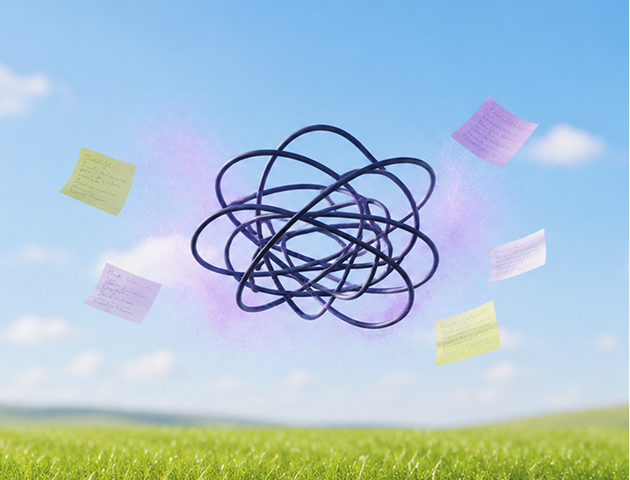

The Scattered Notes Problem
When your ideas live in Notion, then Obsidian, then Apple Notes, then Readwise, then a paper notebook, you spend more time hunting for your own insights than using them. The deeper problem shows up later: you finally find the note you wrote six months ago, and reading it feels like reading a stranger’s handwriting. You captured the idea and then never met it again. Storage was never the hard part.
What fixes this is a system rather than a sixth app. PALA is a four-folder framework that pulls everything into one place, and pairing it with spaced-repetition review keeps the material alive in your head instead of sitting in a folder.
Why Juggling Multiple Note Apps Creates Overwhelm
Each app earns its place for a reason that made sense at the time: Notion for projects, Obsidian for linking, Apple Notes for quick capture, Readwise for annotations, RemNote for study. Five reasonable decisions add up to one unreasonable setup.
The bill arrives as attention debt. Every switch costs you the thread of what you were thinking, and your knowledge ends up split across formats that cannot see each other. A note in Notion cannot link to a note in Obsidian, and your Anki decks are invisible to your project notes. Notes that are everywhere surface nowhere.
One person ran Notion, Readwise, Obsidian, Evernote, Instapaper, and a second Notion account at the same time. That is not a richer system, it is paralysis: the moment an insight arrives, it gets spent on “which app does this go in?” instead of on the insight. Once the cost of choosing a destination exceeds the value of the thought, the setup is working against you. Use one app and organize it properly.
One App, One System: PALA
PALA stands for Projects, Actions, Learnings, Archives. Four folders, any note app, and every note goes in exactly one of them.
The reason it holds up is that the categories are mutually exclusive and completely exhaustive. Mutually exclusive means a note has one home and only one. Completely exhaustive means nothing falls through the cracks. Between those two rules, you never stand over a fresh note wondering where it belongs.
PALA is a variation on PARA (Projects, Areas, Resources, Archives), the better-known version. The swap came from a practical annoyance: separating “Areas” from “Resources” kept producing judgment calls, while a dedicated Learnings folder for study material draws a line you can actually apply.
Projects: Your One-to-Three Priority Items
Projects holds your active work, which is a much smaller set than your important work. If it is not consuming your attention this month, it is not a project.
Cap yourself at one project, three at the absolute most. That limit comes from the 12-week goal-setting approach, and the logic is unsentimental: a brain tracking ten goals is not tracking any of them. Ten projects is not a project list, it is a to-do list you will never finish.
Say you are writing a book, selling a product, and learning a language. Those three fill Projects completely. Publish the book and it drops into Archives, and if a fourth ambition shows up before then, something has to rotate out to Actions or Archives first.
Actions: Everything Else Worth Doing
Everything worth doing that is not a project lands in Actions: personal life, business, relationships, health. Resist the urge to leave it as one long pile. Split it into subfolders along MECE lines, so Personal, Business, Relationships, and Health/Medicine each own their own territory without overlapping.
The test is whether you can place a note without hesitating. “Organize my desk” is Personal. “Negotiate a raise” is Business. “Anniversary gift ideas” goes under Relationships, and “fitness routine ideas” under Health, and neither one has a second plausible home.
Learnings: Your Study Material, Organized by Topic
Learnings is where notes from books, podcasts, documentaries, and interviews accumulate. Subfolder it by subject: Cooking, Languages, Media, Science, Business, Design, whatever you actually study.
Finish a book and the ideas worth keeping go here. Hear something useful in a podcast on a walk, same destination. Keeping this separate from Projects and Actions matters because study material has a different half-life than tasks: a task is done or it is not, while an idea from a book stays valuable for years if you can find it again.
Archives: Dead Weight
Archives takes anything you have not touched in a year or do not expect to need soon. Old notes about music tastes that moved on, notes from a relationship that ended, work notes from a job you left.
The point is not deletion, it is keeping the live system small enough to scan. You stop scrolling past a decade of dead notes to reach the one you need this afternoon, and the old ones are still sitting there if a reason to open them ever appears.
Apple Notes Features That Make PALA Work
Apple Notes looks too plain for this, and it is not. Here is what carries the system:
Toggleable hierarchy: Command+Shift+H makes a big heading, Command+Shift+J a subheading, and both collapse. Command+Shift+7 gives you bullet lists. Collapsing is what lets a long note stay navigable instead of turning into a scroll.
Note linking: Type two angle brackets (<<) anywhere in a note to search and jump straight to another note by title. No copy-pasting text between notes to keep them connected.
Sync and collaboration: Notes move between iPhone, iPad, and Mac on their own. Shared notes update in real time, and the other person can edit from a web browser without owning a single Apple device.
Free: It is already on every Apple device you own.
Plain features, complete system. That combination is why people with genuinely heavy note loads run everything through it: researchers doing PhD-level work, professionals juggling complex projects, students carrying full course loads.
The Missing Piece: Automatic Review Scheduling
PALA solves the scattered notes problem cleanly. One place, predictable structure, no more hunting.
What it does not solve is resurfacing. Write “How to improve at cooking,” file it under Learnings > Cooking, and the note goes quiet until you happen to search for it or trip over it months later. A knowledge base you never revisit is a library you hold a card for and never enter.
Spaced repetition is the fix that memory science keeps confirming. See material once, again in a few days, then a week later, then a month later, and each pass leaves a stronger trace than the last. The gaps widen because a stronger memory survives longer before it fades, which is the same engine running underneath Anki and every serious language app.
Apple Notes has none of this. Neither does Obsidian, Notion, or nearly every note app you might switch to, because they were built to hold knowledge rather than to hand it back to you on a schedule.
Doing the Review Part Without Doing It Yourself
The friction is not in the folders, it is in what happens after them. Once PALA is set up, your Learnings folder fills with notes you meant to revisit and never did, and turning those into something you actually study means manually writing flashcards, then manually deciding which ones to open on which day. Almost nobody sustains that for long.
Picture the same folder behaving differently: you write the note on improving at cooking, and a few days later the ideas in it come back to you as questions, then again a week after that, then a month later, until they are simply things you know.
Fluxo is built for that gap. You organize your own notes into spaces and topics, write them in rich text yourself, and its AI turns those notes into flashcards, quizzes, and summaries, then schedules them with spaced repetition so the material resurfaces over time. Streaks, a companion mascot, and gamified sessions make the reviews something you keep coming back to, and it suggests new topics worth exploring when you are ready for them.
The honest boundary: you write your own notes, because Fluxo has no ready-made courses and no shared deck marketplace. If your knowledge base already lives in Notion or Obsidian, consolidating it is your work to do.
Start at https://fluxo.today.